
Packing light begins before you fold a single shirt. The suitcase itself decides how much you can fit, how easily you can move through the airport, and whether you’ll be stopped at the gate. A carry-on that is too big gets checked. One that is too small forces you to leave things behind. So it’s worth getting this part right.
Know the Size Limits
Most airlines accept carry-on bags around 22 x 14 x 9 inches (56 x 36 x 23 cm), including wheels and handles, though limits vary by carrier, and low-cost airlines are often stricter. A 20-inch suitcase is the safest choice because it fits within the limits of most airlines. Always check your airline’s current rules before you fly.
Why Hardshell Works Well for Packing
A hardshell suitcase protects what’s inside, and its two-sided structure makes packing easier. You can keep shoes and toiletries on one side and clothes on the other, then close it without fighting a bulging zipper. Modern ABS and polypropylene shells are also light, so more of your weight allowance goes to your belongings rather than the bag. Both materials resist scratches, which helps a bag that will be lifted into overhead bins again and again.
Look for Expandability
A week of travel often ends with more luggage than it began with, whether from souvenirs, shopping or wet swimwear. An expandable carry-on gives you extra room for the trip home. Keep it zipped in its compact size for the flight there, then expand it if you need to. The Joyway 20″ Expandable Carry-On is built for exactly this. It has spinner wheels for smooth movement through busy terminals and a built-in TSA lock for security.
Choose Durability If You Fly Often
If you take several trips a year, the corners are what wear out first, since they take the most impact in overhead bins and baggage systems. The Joyway 20″ Carry-On with Metal Corner Protectors adds reinforcement where it matters most, along with spinner wheels and a TSA lock. It’s a solid pick for frequent flyers who want their bag to look good after many trips.
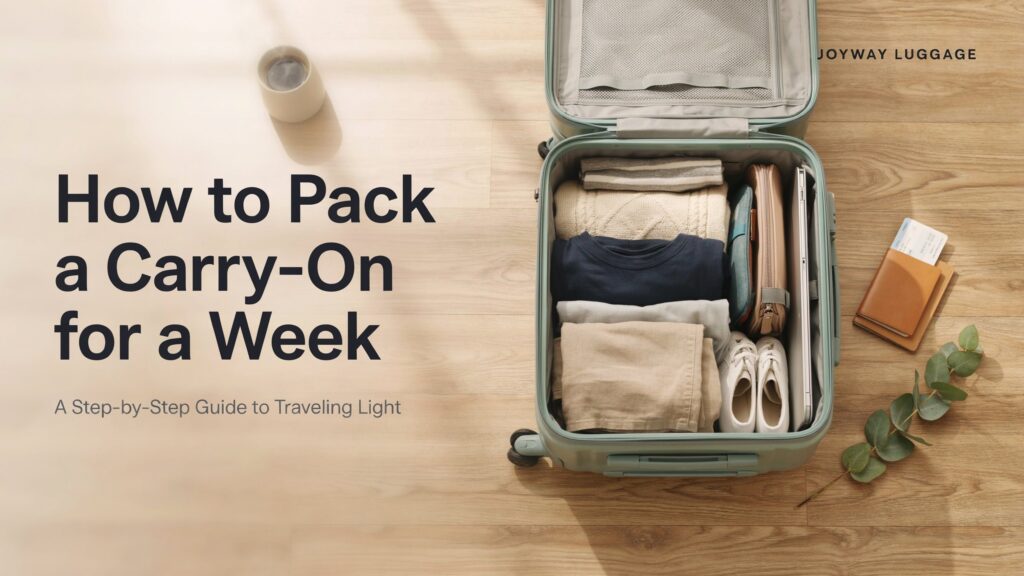
2. Plan Outfits Before You Pack
The biggest packing mistake happens before the suitcase is even open: throwing in clothes “just in case.” A week-long carry-on works when every item has a job. Planning your outfits first keeps the bag light, the choices simple, and the unworn-clothes pile small.
Start With a Color Palette
Pick two or three neutral base colors, such as black, navy, beige or gray, and add one or two accent colors. When everything coordinates, any top works with any bottom, so a small number of items can create many different outfits. Avoid one-off pieces that only match a single item.
Try the 5-4-3-2-1 Method
This simple formula is a good starting point for a seven-day trip:
- 5 tops: a mix of T-shirts, shirts or blouses
- 4 bottoms: for example, two pairs of pants, shorts or a skirt
- 3 layers: a light jacket, a sweater or a cardigan
- 2 pairs of shoes: one comfortable pair for walking and one dressier pair
- 1 accessory set: a scarf, a hat or a belt, depending on your destination
Underwear, socks and sleepwear go on top of this base. Treat the formula as a guide, not a rule. Adjust the numbers to your trip, your style and your laundry options.
Check the Weather and Your Activities
Look up the forecast for each day and list what you’ll actually be doing: business meetings, hiking, beach time, dinners out. Match each activity to an outfit on paper. If an item doesn’t fit any planned outfit, leave it at home. Layers work better than bulky single pieces. A light sweater under a jacket gives you more combinations than one heavy coat, and it takes far less space.
Do a Trial Run
Lay out all your chosen outfits on the bed, or take a quick photo of each one. This helps you spot duplicates and gaps. Then remove one or two items. Most travelers find that the last things they add are the first things they never wear.
3. The Packing Methods Compared
Once your outfits are chosen, how you pack them matters almost as much as what you pack. There is no single best method. Each one saves space or protects clothes in a different way, and most travelers get the best results by combining two or three.
Rolling
Rolling means tightly rolling each item into a cylinder and lining the rolls up in the suitcase. It works well for T-shirts, jeans, leggings, casual pants and knitwear. Rolled clothes fill gaps efficiently and let you see everything at a glance, so you don’t have to dig through layers to find one shirt.
The downside is that rolling can leave soft creases in some fabrics, and it works poorly for structured pieces like blazers or stiff collars.
Folding and Bundle Wrapping
Flat folding stacks neatly in a hardshell suitcase, especially for shirts, dresses and trousers. Bundle wrapping goes a step further. You wrap clothes around a central core, such as a toiletry bag or a small pouch, with the most wrinkle-prone items on the outside. Fewer sharp fold lines means fewer wrinkles, which makes this method a good choice for business clothes.
It takes more time to learn, and unpacking means undoing the whole bundle, but it keeps formal clothes looking sharp.
Packing Cubes
Packing cubes are zippered fabric organizers that divide the suitcase into sections, such as tops, bottoms, underwear and sleepwear. Compression cubes squeeze out extra air for even more room. Cubes keep a bag organized, make security checks easier and let you move a whole category of clothes into a hotel drawer in seconds.
They add a little weight of their own, and it’s tempting to overfill them, so keep an eye on the total weight of the bag.
Quick Comparison
| Method | Space Saved | Wrinkle Risk | Best For |
|---|---|---|---|
| Rolling | High | Medium | Casual clothes, T-shirts, jeans, knitwear |
| Folding | Medium | Low to medium | Shirts, dresses, structured items |
| Bundle wrapping | Medium to high | Low | Business and formal clothes |
| Packing cubes | High (with compression) | Medium | Organization, longer trips, shared luggage |
Combine Methods for the Best Result
A practical approach for a one-week carry-on:
- Roll casual items such as T-shirts, shorts and leggings.
- Fold dressier pieces and place them flat on one side of the suitcase.
- Use packing cubes to separate categories and keep the bag tidy.
A two-sided hardshell suitcase makes this easier. You can keep folded items on one side and rolled items or cubes on the other, then close the lid without forcing it. If your set includes a matching toiletry bag or small case, use it as the core for bundle wrapping or as a dedicated pouch for electronics and cables.
4. What Goes Where: Packing the Suitcase Layer by Layer
A well-packed suitcase is balanced, protected and easy to open at a hotel or a security checkpoint. Think of it in layers, with the heaviest items at the bottom and the most delicate or most needed items at the top.
Layer 1: Heavy Items Near the Wheels
Place shoes, a hair dryer, a laptop in its sleeve or any other heavy items at the wheel end of the suitcase, which is the bottom when it stands upright. This keeps the center of gravity low, so the bag rolls smoothly and doesn’t tip over when you let go of the handle. Stuff shoes with socks, chargers or small accessories, and put each pair in a shoe bag or a plastic bag so dirty soles don’t touch your clothes. Place them sole against the wall of the suitcase, not flat on top of clothing.
Layer 2: Clothing in the Middle
Your main clothing goes in the center of the suitcase. Lay folded items flat or arrange rolls and packing cubes in tight rows with no gaps. Put the bulkiest items, such as sweaters and jeans, at the bottom of this layer, and lighter or wrinkle-prone items like shirts and dresses above them. Fill any gaps around the edges with socks, underwear or belts. Every empty pocket of space is room you can use.
Layer 3: Fragile and Essential Items on Top
The top layer, the first thing you see when you open the lid, is for items you need quickly or that must not be crushed. This includes chargers, adapters, a light jacket, a sleep mask and your liquids bag if you need to take it out for security. Delicate items such as sunglasses should be in a hard case or wrapped in clothing, and placed where nothing heavy can press on them.
Use Both Halves of the Hardshell
A hardshell suitcase opens into two compartments, and using them well makes a big difference:
- One side for hard or bulky items: shoes, toiletries and electronics, where the shell offers protection
- The other side for soft items: folded clothes, held in place by the zippered divider or compression panel
Keep the weight roughly equal on both sides. This stops the suitcase from bulging unevenly and makes it easier to close. Close the lid gently, and if it needs force, remove one item instead of pushing. Overstressing zippers and shell edges is one of the most common causes of damage.
A Quick Packing Order
- Shoes and heavy items at the wheel end
- Bulky clothing next, filling gaps as you go
- Lighter and dressier clothing above
- Toiletry bag, chargers and fragile items last
- Documents, medications and valuables in your personal item, not the suitcase
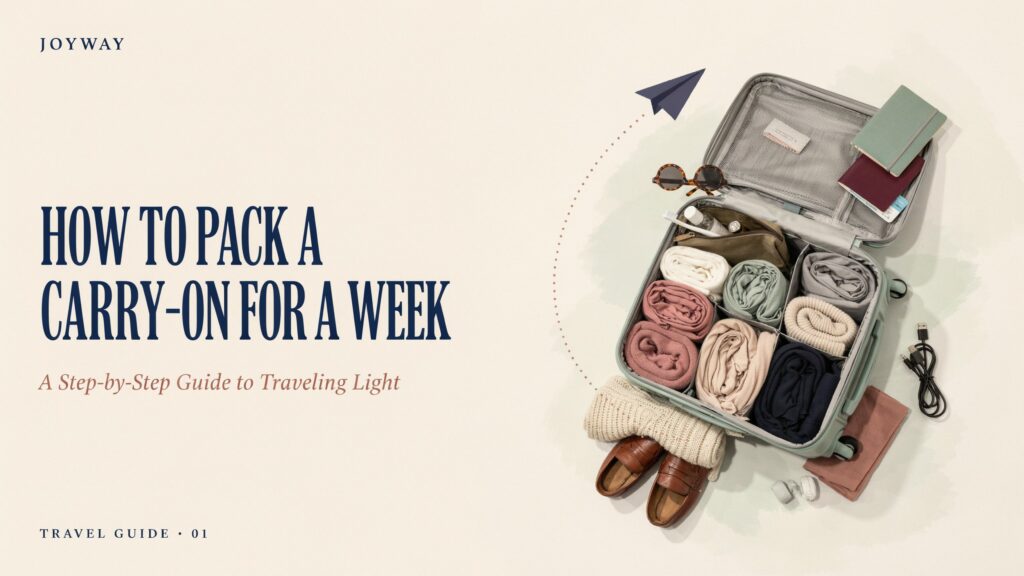
5. Use the Whole Set: Personal Item, Duffel, and Toiletry Bag
A carry-on suitcase is only part of the picture. Most airlines let you bring a second, smaller bag on board, usually called a personal item, and using it well can double your packing space without a checked-bag fee. This is where a luggage set pays off: the extra pieces are designed to work together.
Your Personal Item: The Everything-You-Need Bag
Your personal item should hold what you want within reach during the journey and what you can’t risk losing:
- Passport, ID, boarding pass and travel documents
- Phone, charger, power bank and headphones
- Medications and any essentials you’d need if your suitcase were delayed
- One spare outfit and a light layer
- A book, snacks and an empty water bottle to fill after security
Personal item size limits vary by airline, so check the rules for your carrier. As a rule, it must fit under the seat in front of you.
The Joyway 3-Piece Luggage Set is a good example. It combines a 20″ carry-on suitcase, a travel duffel bag and a toiletry bag, which covers a short trip without any extra purchases. The duffel can serve as your personal item for the flight, then double as a day bag or weekend bag once you arrive.
Pack the Toiletry Bag With Security in Mind
Liquids are the most common reason for a slow trip through security. In the US, the TSA’s 3-1-1 rule allows containers of up to 3.4 oz (100 ml) each, all fitting in one clear quart-size bag. Rules differ in other countries, so check the regulations for every airport on your route.
A few ways to keep things simple:
- Decant into travel-size bottles instead of bringing full-size products
- Use solid alternatives such as shampoo bars, solid deodorant and toothpaste tablets
- Keep the liquids bag at the top of your suitcase or in your personal item so you can remove it quickly
- Put a leak-proof layer around the bottles, such as a zip bag inside the toiletry bag
Every Joyway set includes a toiletry bag, so you don’t need to buy a separate one. Keep it at the top of the suitcase on travel days.
Add Organization With a Smaller Case
If you like to keep electronics, cosmetics or documents separate, a small hard case is handy. The Joyway 4-Piece Luggage Set adds a compact 13″ case to the 20″ carry-on, travel bag and toiletry bag. It works well for:
- Cables, chargers and adapters
- Makeup and skincare
- Jewelry and small accessories
- Spare underwear and socks for the flight, in case your bag is delayed
Because it’s rigid, it also protects fragile items better than a soft pouch.
Nesting Saves Space at Home
One more benefit of a set: the pieces are designed to fit inside each other, so storing them takes much less space than buying separate bags. Smaller pieces tuck into the larger suitcase between trips.
6. One-Week Carry-On Packing List
Here is a complete checklist you can use as a starting point. It’s built around the 5-4-3-2-1 method from section 2 and fits a standard 20″ carry-on plus a personal item. Adjust the quantities to your destination, your activities and your laundry options.
Clothing
- 5 tops (T-shirts, shirts or blouses)
- 4 bottoms (pants, jeans, shorts or skirts)
- 3 layers (light jacket, sweater or cardigan, and a rain layer if needed)
- 7 pairs of underwear (or 4-5 if you plan to wash)
- 5-7 pairs of socks
- 1-2 sets of sleepwear
- 1 swimsuit (if relevant)
- 1 dressier outfit for dinners or events
Shoes and Accessories
- 1 comfortable pair for walking (wear them on the plane)
- 1 second pair, such as dressier shoes or sandals
- Belt, scarf or hat
- Sunglasses in a hard case
Toiletries (in your toiletry bag)
- Toothbrush, toothpaste and floss
- Shampoo and conditioner (travel-size or solid)
- Deodorant
- Skincare and sunscreen
- Razor and personal care items
- Hairbrush or comb
- Makeup and remover, if you use them
- Contact lenses, solution and a spare pair of glasses
Reminder: liquids must follow airline and airport limits, so keep each container within the allowed size and pack them in a clear bag.
Electronics
- Phone and charger
- Power bank (must go in carry-on, not checked luggage)
- Travel adapter for your destination
- Headphones
- Laptop or tablet and charger, if needed
- Charging cables in a small pouch or case
Documents and Money (in your personal item)
- Passport or ID
- Boarding passes and booking confirmations
- Travel insurance details
- Credit cards, some cash and local currency
- Copies of key documents, stored digitally and on paper
Health and Comfort
- Prescription medication in original packaging
- Basic first aid items (pain relief, plasters, motion sickness tablets)
- Hand sanitizer and tissues
- Reusable water bottle (empty for security)
- Neck pillow and sleep mask for long flights
Optional Extras
- Packing cubes or compression bags
- Small laundry bag for worn clothes
- Travel-size laundry detergent or wipes
- Foldable tote for shopping and souvenirs
- A book or e-reader
Before You Close the Suitcase
- Check the weight against your airline’s limit
- Make sure your valuables and documents are in your personal item
- Set your TSA lock and note the code
- Add a luggage tag with your contact information
- Take a quick photo of the packed suitcase in case of loss or delay
7. Common Carry-On Packing Mistakes
Even experienced travelers fall into the same traps. Knowing them in advance can save you stress at the airport and money on baggage fees.
Mistake 1: Packing “Just in Case” Items
The “what if” mindset is the fastest way to overpack. What if it’s cold? What if there’s a fancy dinner? What if I need a third pair of shoes? Most of these scenarios never happen, and almost anything can be bought or borrowed at your destination if you really need it.
The fix: For every item you hesitate over, ask yourself, “Would I buy this at my destination if I needed it?” If the answer is yes, leave it at home. Stick to the outfit plan from section 2, and keep the “maybe” pile out of the suitcase.
Mistake 2: Ignoring Airline Size and Weight Limits
Carry-on rules vary a lot between airlines. Some carriers weigh bags at the gate, and low-cost airlines are known for being strict about both dimensions and weight, often with significant fees for exceeding them. A suitcase that passed easily on one airline may be rejected on another.
The fix: Check your airline’s current carry-on policy before you pack, and again before you leave for the airport. Weigh your packed suitcase at home with a luggage scale or a bathroom scale, and remember that wheels and handles count toward the size limit.
Mistake 3: Packing Liquids in the Wrong Place
A leaking bottle can ruin a whole suitcase of clothes, and a liquids bag buried at the bottom slows down everyone in the security line. Oversized containers are confiscated on the spot, even if they’re only half full.
The fix: Use containers within the allowed limit, close each bottle tightly and put it inside a sealed bag. Keep the liquids bag on top or in your personal item so it comes out in seconds. A spare zip bag takes almost no space and is worth having.
Mistake 4: Leaving No Room for the Trip Home
Souvenirs, shopping and slightly damp clothes all take more space than they did on the way out. Travelers who pack to the very last inch often end up wearing extra layers through the airport or paying for a checked bag.
The fix: Leave about 10-15% of the suitcase empty on departure, or choose a model with an expansion zipper and use it only when you need it. A foldable tote bag also helps, since it takes almost no space on the way out and gives you extra capacity on the way back.
Mistake 5: Putting Valuables and Essentials in the Wrong Bag
Carry-on suitcases are sometimes gate-checked when overhead bins fill up. If your medication, documents, chargers and valuables are inside, you won’t have access to them during the flight, and they’ll be out of your sight.
The fix: Keep passports, medication, electronics and anything irreplaceable in your personal item, which stays under the seat in front of you.
Mistake 6: Packing Unevenly
A suitcase with all its weight on one side or at the top is difficult to roll and prone to tipping over. Uneven loads also strain the zipper and the hinge of a hardshell case.
The fix: Follow the layering approach from section 4: heavy items near the wheels, balanced weight on both halves and fragile items on top.
Quick Self-Check Before You Leave
- Does the suitcase close without force?
- Is it within your airline’s size and weight limits?
- Are the liquids in a clear bag, easy to reach?
- Are your documents and valuables in your personal item?
- Is there space left for the trip home?
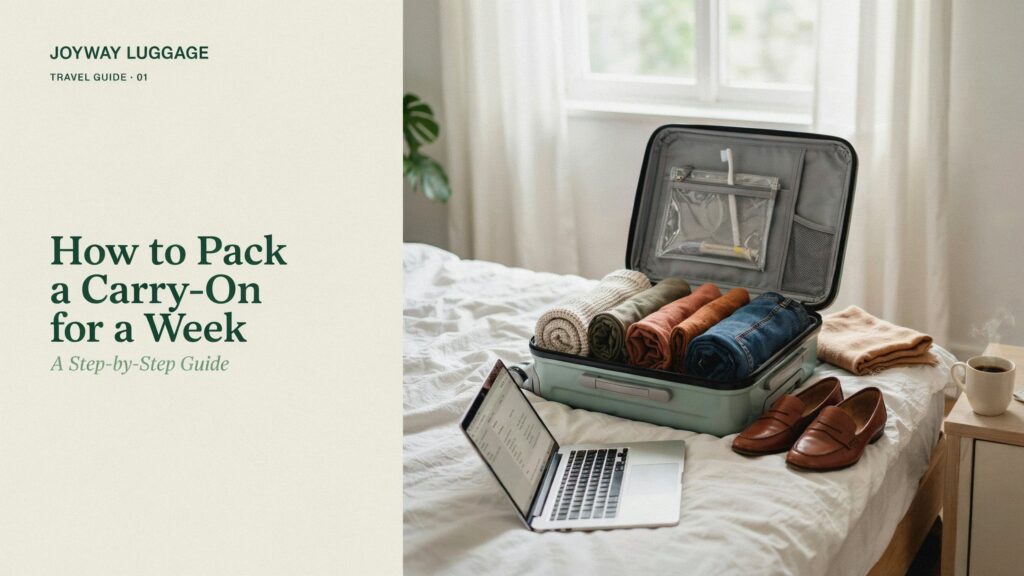
8. Make Room for the Trip Home
The trip home is where a carry-on-only plan often falls apart. Souvenirs, new purchases and slightly damp clothes all take up more space than they did on the way out. With a little planning, you can leave with a tidy suitcase and come back with one that still closes.
Use the Expansion Feature Wisely
Many carry-ons have an expansion zipper that adds extra capacity by increasing the depth of the case. It’s a useful feature, but it has one catch: an expanded suitcase may no longer meet your airline’s size limits.
- On the way out: keep the suitcase zipped in its compact size, so it fits the sizer at the gate
- On the way home: expand it only if you need to, and check your airline’s rules before doing so
- Don’t overfill: an expanded bag that is packed to bursting puts stress on the zippers and the shell
The Joyway 20″ Expandable Carry-On is designed for this approach. Pack it compactly for the flight there, then use the extra space when you come back with more than you took.
Do Laundry on the Road
The easiest way to pack less is to wash what you wear. A week of clothes can easily become a few days of clothes plus one wash.
Sink washing (5 minutes):
- Fill the sink with warm water and a small amount of travel detergent or a few drops of shampoo
- Soak and gently rub the items, then rinse well
- Squeeze out the water without wringing, which can damage fabrics
- Roll the item in a towel and press to remove more moisture
- Hang it up overnight, ideally near a window or away from the AC
Other options:
- Hotel or local laundry service: a good choice for longer trips or bulkier items
- Self-service laundromat: often cheap, and a chance to see a bit of local life
- Laundry sheets or detergent strips: lightweight and TSA-friendly, and they take almost no space
Quick-drying fabrics such as synthetics, merino wool and some blends dry overnight, while heavy cotton and denim can take a full day or more. If laundry is part of your plan, choose your clothes accordingly.
Keep Clean and Dirty Clothes Separate
Dirty clothes mixed with clean ones make the whole suitcase feel full and can leave everything smelling stale. Bring a lightweight laundry bag or a spare packing cube, and use it from the first day. This also makes unpacking at home easier: you can empty the dirty bag straight into the washing machine.
Pack Smart for Souvenirs
- Bring a foldable tote bag. It takes almost no space on the way out and acts as an extra bag on the way back, ideally as your personal item
- Wear your bulkiest items on the plane. Heavier shoes and jackets can be worn to free up space in the suitcase
- Wrap fragile souvenirs in clothing. The soft items protect them, and you save on bubble wrap
- Ship larger purchases home. For big or heavy items, local postal services can be cheaper than baggage fees
- Check the weight. Weigh the suitcase before you leave your hotel, so you aren’t surprised at the check-in desk
Plan a Smaller Load for the Return
Since you’ll have washed or worn some items, the return suitcase should be organized differently:
- Put worn clothes in the laundry bag at the bottom
- Place shoes and heavy souvenirs near the wheels
- Layer clean clothes and fragile items on top
- Keep documents, medications and valuables in your personal item
9. Best Joyway Luggage for Carry-On Travelers
The right set depends on how you travel. Here’s how Joyway’s collections match different needs, from a quick weekend away to a trip where you might need to check a bag.
For the Solo or Weekend Flyer: Joyway 3-Piece Luggage Set
This is the simplest way to travel carry-on only. The set includes a 20″ hardside carry-on, a travel duffel bag and a toiletry bag, which covers a long weekend or a short business trip without extra purchases.
- 20″ ABS hardshell carry-on (about 21 x 14.1 x 9.4 in), lightweight and scratch-resistant
- Spinner wheels that are removable, so they can be replaced if damaged
- Built-in TSA lock for security
- Duffel bag that works as your personal item on the plane
Best for: short trips, business travel, anyone who wants to avoid checked bag fees.
See the Joyway 3-Piece Luggage Set →
For the Organized Minimalist: Joyway 4-Piece Luggage Set
If you like to keep things sorted, this set adds a compact 13″ case to the 20″ carry-on, a travel bag and a toiletry bag. The small case is ideal for electronics, cosmetics or documents.
- Hardshell suitcases with 360° spinner wheels
- Expandable 20″ carry-on for extra room on the return trip
- TSA-approved lock on the main suitcase
- Extra case for items you want to keep separate
Best for: week-long trips, travelers who value organization, anyone who packs with cubes and categories.
See the Joyway 4-Piece Luggage Set →
For Travelers Who May Need to Check a Bag: Joyway 5-Piece Luggage Set
Sometimes a trip is longer than planned, or the return suitcase gets heavier. This set gives you flexibility with three suitcase sizes, a duffel and a toiletry bag. Use the 20″ carry-on for short trips and bring the larger pieces when you need them.
- 20″ and 24″ expandable suitcases, plus a 28″ checked suitcase
- Expandable duffel and toiletry bag
- TSA lock and spinner wheels on the suitcases
- Available in ABS and polypropylene (PP) hardshell versions
- Nesting design that saves storage space at home
Best for: vacations of varying length, couples sharing a set, travelers who want one purchase for all trip types.
See the Joyway 5-Piece Luggage Set →
For Families and Longer Trips: Joyway 6-Piece Hardshell Luggage Set
When several people travel together, or a trip stretches beyond a week, a larger set gives everyone their own bag.
- Impact-resistant, scratch-resistant ABS shell
- Spinner wheels and TSA lock
- Multiple sizes to share between family members, with a carry-on for each traveler if needed
Best for: family trips, group travel, long vacations.
See the Joyway 6-Piece Hardshell Luggage Set →
For Frequent Flyers: Joyway 20″ Carry-On With Metal Corner Protectors
If you travel often and want a single bag that holds up, this carry-on adds reinforcement where suitcases take the most punishment.
- Metal corner protectors to reduce wear from bins and baggage handling
- Lightweight hardshell construction
- TSA lock and spinner wheels
Best for: frequent flyers, business travelers, anyone who wants one durable carry-on.
See the Joyway 20″ Carry-On With Metal Corner Protectors →
For the Ultralight Packer: Joyway 20″ Polypropylene Carry-On
Polypropylene is a lightweight, flexible material that handles impact well, which leaves more of your weight allowance for your belongings.
- Lightweight PP hardshell
- Swivel wheels for smooth movement through terminals
Best for: travelers close to airline weight limits, anyone who values low weight above all.
See the Joyway 20″ Polypropylene Carry-On →
Quick Comparison
| Set | Pieces | Best For | Highlights |
|---|---|---|---|
| 3-Piece | Carry-on, duffel, toiletry bag | Weekend and business trips | Removable spinner wheels, TSA lock |
| 4-Piece | 13″ case, 20″ carry-on, travel bag, toiletry bag | Organized week-long trips | Expandable, extra small case |
| 5-Piece | 20″, 24″, 28″, duffel, toiletry bag | Flexible travel, checked bags | ABS or PP, nesting design |
| 6-Piece | Multiple suitcases and bags | Families, long trips | Scratch-resistant ABS |
| 20″ Corner Protectors | Single carry-on | Frequent flyers | Metal corner reinforcement |
| 20″ PP Carry-On | Single carry-on | Ultralight packers | Polypropylene shell |
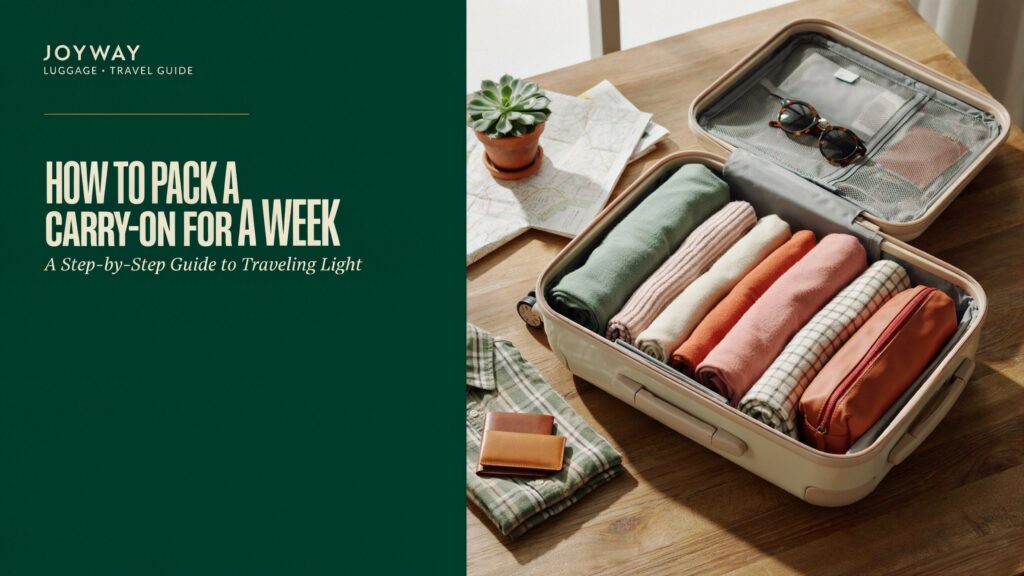
FAQ
Can I really pack a week of clothes in a carry-on?
Yes. With a planned wardrobe (such as the 5-4-3-2-1 method), a mix-and-match color palette and efficient packing methods like rolling and packing cubes, a week of clothing fits in a standard 20″ carry-on. Wearing your bulkiest items on the plane and doing a quick wash mid-trip makes it even easier.
What size is a carry-on suitcase?
Most airlines allow carry-on bags of around 22 x 14 x 9 inches (56 x 36 x 23 cm), including wheels and handles. Limits vary by airline, and low-cost carriers are often stricter, so always check your airline’s current policy before you fly. A 20″ suitcase fits the limits of most carriers.
Is rolling or folding better?
It depends on the clothes. Rolling saves space and works well for T-shirts, jeans and knitwear. Folding or bundle wrapping suits shirts, dresses and formal clothes, since it causes fewer wrinkles. Most travelers get the best results by combining both.
Do packing cubes actually help?
They do, mainly for organization. Cubes keep categories of clothing separate, make security checks easier and let you move items to a hotel drawer in seconds. Compression cubes can also save extra space. Just keep an eye on the total weight, because cubes make it easy to overpack.
What should I never put in a carry-on?
Items that are restricted include liquids over the allowed container size, sharp objects such as knives and scissors with long blades, and certain flammable items. Rules differ by country and airline, so check the regulations for your route. Note that power banks and spare lithium batteries must go in your carry-on, not in checked luggage.
Should I buy a luggage set or a single carry-on?
If you only fly carry-on, a single 20″ suitcase may be enough. A set is worth considering if you want a matching duffel for your personal item, a toiletry bag, or the option to use larger sizes for longer trips. Sets also nest together, which saves storage space at home.
Are hardshell suitcases good for carry-on travel?
Yes. A hardshell protects your belongings, resists scratches and splits into two compartments that make packing easier. Materials like ABS and polypropylene are also lightweight, which leaves more of your weight allowance for your belongings.
Conclusion
Traveling for a week with only a carry-on is not about sacrifice. It’s about planning. Choose a suitcase that fits airline limits, plan your outfits around a simple color palette, pack in layers with the heaviest items near the wheels, and use every part of your luggage set, from the personal item to the toiletry bag. Leave a little space for the trip home, and you’ll skip the baggage fees, the waiting at the carousel and the worry about lost luggage.
The right gear makes all of this easier. Whether you need a simple 3-piece set for weekend trips, a flexible 5-piece set for longer vacations, or a durable carry-on with metal corner protectors for frequent flights, Joyway Luggage has an option that fits how you travel.
Browse the Joyway Luggage collection → and find the carry-on that will take you on your next trip, with room to spare.